· 7 min read · Omkar Satpute and Milind Soni
Which AI agent should I use? A five-question decision
Five questions that decide between Meta Muse, Grok Bot, OpenAI dots, Cue, and MausBot: one agent or a team, your plan, your region, your data, and uptime.
It depends on five questions, and most people only need two of them. Do you want one assistant or a team? Which subscription do you already pay for? Where do you live? Where may your data live? Does it have to keep working with your laptop closed? Answer those and the field of five, Meta Muse, xAI Grok Bot, OpenAI dots, Cue by Manus, and MausBot, narrows to one or two. The short version: one assistant from a big lab means Muse or dots; a team of agents means Grok Bot, Cue, or MausBot; and if the answer to the data question is "on my own disk," there is only MausBot.
This is a decision guide, not a ranking. Every product below is described from its own launch post, docs, or store listing, with the link inline. For the full feature table see Muse vs Grok Bot vs Dots vs Cue. Here we only ask the questions that change the answer.
1. Do you want one assistant or a team?
This is the first fork, and it removes half the field. Meta Muse is one agent per person; it spawns hidden subagents, but you cannot create a second one with its own job. OpenAI dots are one primary dot today that you name; OpenAI says it envisions teams of dots over time, with no date and no price for extra dots. Both products are built on the idea that one agent already knows you, and it works because it is the only one.
The other three ship a roster. Grok Bot is a messaging app of named bots with group chats of two to six and @mentions. Cue gives several agents their own identity, each with an email address, a phone number, and a wallet, and lets them collaborate in one conversation. MausBot is a chat app where every contact is a bot, with unlimited bots, group rooms where one bot answers or all do or only the @mentioned one, and hand-offs between bots that you approve.
Verdict. One assistant: Muse or dots. A team: Grok Bot vs MausBot, Cue, or MausBot. If you do not know yet, you want a team; a team of one is still a team, and you can add the second bot the day you need it.
2. Which subscription do you already pay for?
Three of the five do not sell you a model; they attach to a plan you already have. That makes this the cheapest question to answer, so answer it before you look at any feature list.
ChatGPT Pro or Business Premium. Dots are included, with the first dot at no extra cost. Pro is reported from $100 a month. ChatGPT Plus. Dots are not available on Free, Go, or Plus. MausBot runs bots on the codex CLI, which signs in with a ChatGPT account, so a Plus subscriber gets a GPT agent that way. SuperGrok or Cursor Pro. Grok Bot is included from SuperGrok and Cursor Pro (list prices $30 and $20), with its own weekly allowance that xAI does not publish. MausBot runs on the grok CLI with the same login. Claude Pro or Max. None of the closed four take a Claude plan. MausBot runs on the claude CLI with your existing login. None of the above. Muse has a free tier metered in weekly tokens, with a card at signup per press reports, in the US and Canada. MausBot takes an API key from any provider or an OpenAI-compatible endpoint, which is how a local model works too.
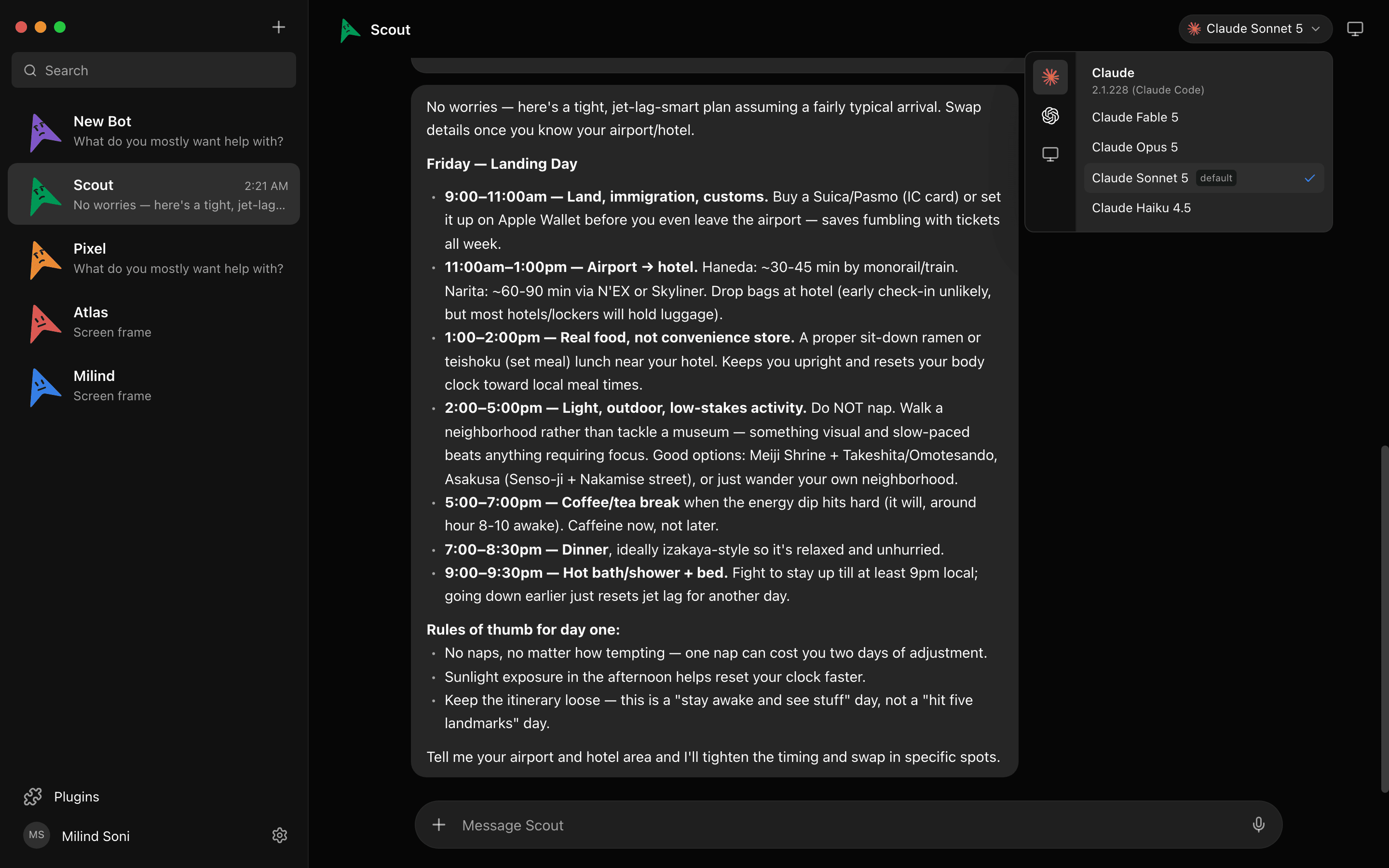
Verdict. ChatGPT Pro or Business Premium: dots. ChatGPT Plus: MausBot on codex. SuperGrok or Cursor: Grok Bot, or MausBot on grok. Claude: MausBot on claude. Nothing: Muse's free tier if you are in the US or Canada, otherwise MausBot with an API key. The one thing no closed agent offers is two of these plans in one room, which is the reason MausBot shows up in every line of that list.
3. Where are you?
Two of the five will not let you in at all depending on your address, so check this before you get attached. Muse is US and Canada only, 18 and over, with Canada opened on September 18 and no UK or EU date. Dots on ChatGPT Pro exclude the EEA, Switzerland, and the UK, and OpenAI has said a Pro launch there is not planned for now; dots on Business Premium cover every region where ChatGPT is sold. Grok Bot's plan post and docs publish no region list. Cue publishes no region restriction, but it is early access behind an invite code, with the launch code reported capped at 1,000 users. MausBot has no region check; it runs wherever your model login works, or air-gapped with a local model.
Verdict. US or Canada: all five, Cue with an invite. Elsewhere outside Europe: Grok Bot, dots, Cue with an invite, MausBot. EEA, Switzerland, or UK: Grok Bot, dots only on Business Premium, Cue with an invite, MausBot. The Instinct crowd waiting on an invite has the same problem Cue's does: a product you cannot start today is not a product you can pick today.
4. Where may your data live?
The four closed agents all work from a computer in their maker's cloud, so your transcripts, your connected-app tokens, and whatever the agent read on your behalf live there too. The details differ in ways that matter. Meta's security post is candid: Meta can access Muse VM data today, a confidential VM is promised later, and training on sanitized trajectories is opt-out. OpenAI's dots FAQ says a dot's memory is kept for as long as you keep the dot, you cannot view, edit, or delete individual memories, only a full Reset, and disconnecting an app does not delete what the dot learned from it. Grok Bot runs every bot on one shared cloud computer per account, and xAI's docs say not to use separate bots as a security boundary. Cue follows Manus's privacy terms; a third-party audit places the data in the US and Singapore.
MausBot is the inversion. A small harness on 127.0.0.1 owns every agent process, and the full conversation record, keys, and events live in ~/.openmausbot on your disk. There is no MausBot server to train from; what leaves the machine is what you send to the model you chose, under that provider's own terms. Shell commands and file edits surface as Allow and Deny cards before they run, with a decision log, and the whole codebase is Apache 2.0, so the gate is something a reviewer can read rather than take on trust. What your bot keeps, and where, is in What your bot remembers.
Verdict. If "in a vendor's cloud" is acceptable, all five remain, and Muse is the most candid about what that means. If the answer is "on my own disk," or if someone in security has to sign off, it is MausBot alone.
5. Does it have to keep working with your laptop closed?
Here the closed four have the honest advantage, and it is worth stating plainly. Because Muse, Grok Bot, dots, and Cue run in their makers' clouds, they all keep going with your phone in your pocket and your laptop shut. Muse runs goals after the app is closed; Grok Bot runs up to 50 routines per bot; dots run scheduled tasks and read-only background research; Cue runs automations on a schedule or an event.
MausBot starts on the machine in front of you, where your files and browser sessions already are, which is the point, and also the limit: a closed laptop runs nothing. There are three ways around it. Give a bot a cloud desktop from the Computer panel, and that bot keeps working. Run npx openmausbot serve on a VPS, Docker, or a Tailscale node, and the whole team does, with routines on a schedule or a webhook. Or take Pro, $49 a month, which gives one person an always-on cloud workspace, cloud computers included within fair use, and scheduled tasks in the cloud.
Verdict. If you want always-on with no setup, any of the closed four. If you want always-on and your own machine, MausBot with a cloud computer, a server, or Pro. If the agent only needs to work while you do, MausBot's free app is enough.
The decision in one table
| If you... | Pick... |
|---|---|
| want one assistant and zero setup, and live in the US or Canada | Meta Muse |
| pay for ChatGPT Pro or Business Premium and live in ChatGPT, Slack, or Teams | OpenAI dots |
| pay for ChatGPT Plus | MausBot on the codex CLI (dots are not on Plus) |
| pay for SuperGrok or Cursor Pro and want a roster of bots today | Grok Bot, or MausBot on the grok CLI |
| pay for Claude Pro or Max | MausBot on the claude CLI |
| pay for nothing | Muse's free tier in the US or Canada; MausBot with a local model anywhere, or an API key paid per use |
| are in the EEA, Switzerland, or the UK | Not Muse, not dots on Pro; MausBot has no region check |
| want agents that phone, pay, and email as themselves | Cue by Manus, if you have an invite |
| need the transcripts and keys on your own disk | MausBot |
| need it running with the laptop closed and want no setup | Any of the four closed agents; MausBot with a cloud computer or Pro |
| want two models in one conversation | MausBot |
| have a security review to pass | MausBot, the only one a reviewer can read |
The honest case for each
Meta Muse is the right pick for someone in the US or Canada who wants one assistant that needs no setup, phones a restaurant on their behalf, and already lives in WhatsApp and Instagram.
Grok Bot is the right pick for a SuperGrok or Cursor subscriber who wants a roster of bots today, a marketplace of templates, and teach-by-recording as it rolls out, and does not need a second model.
OpenAI dots are the right pick for a ChatGPT Pro subscriber outside the EEA, Switzerland, and the UK, or a Business Premium team anywhere, who wants one agent that inherits their ChatGPT memory and 4,000+ apps.
Cue by Manus is the right pick for someone with an invite who wants agents that can call, pay, and email as themselves, and is fine with a closed model in Manus's cloud.
MausBot is the right pick for someone who already pays for Claude, ChatGPT, or Grok, wants more than one model, wants the agent to ask before it acts, and needs their data on their own disk. It is published on GitHub as MausBot, free, Apache 2.0, and a young project at about 3,200 stars.
Frequently asked questions
- Which AI agent is free?
- MausBot is free and open source; you pay only your model provider, which can be a plan you already have. Meta Muse has a free tier metered in weekly tokens, in the US and Canada, with a card at signup per press reports. Cue by Manus is free during invite-only early access with a paid Plus tier implied. Grok Bot has no free tier; it comes with SuperGrok or Cursor Pro and up (list prices $30 and $20). Dots need ChatGPT Pro, reported from $100 a month, or Business Premium.
- Which AI agent works in the EU?
- Muse is US and Canada only. Dots on ChatGPT Pro exclude the EEA, Switzerland, and the UK, and OpenAI has said a Pro launch there is not planned for now; dots on Business Premium cover every ChatGPT region. Grok Bot publishes no region list. Cue publishes no region restriction but needs an invite code. MausBot has no region check and runs wherever your model login works.
- Which AI agent is open source?
- Only MausBot, published on GitHub as MausBot under Apache 2.0. Muse, Grok Bot, dots, and Cue are closed. Meta has said open weights for its Spark model are on the roadmap with no date, and that would not make the Muse agent itself self-hostable.
- Can I use two models at once?
- Only in MausBot. Each bot has its own model, so a Claude bot and a Codex bot can sit in the same room and hand work to each other, and you can switch a bot's model mid-conversation. Muse is Muse Spark only, Grok Bot is Grok only, dots are GPT-6 Astra only, and Cue does not disclose its model.
- Which AI agent is safest for private data?
- MausBot keeps the full conversation record, keys, and events in ~/.openmausbot on your disk, behind a harness on 127.0.0.1; nothing leaves unless you send it to the model you chose. The closed four run in their makers' clouds. Meta says it can access Muse VM data today. OpenAI keeps a dot's memory for as long as you keep the dot with no per-item delete. Muse and dots both say prompt injection is not solved.
Get started in two minutes
No invite code, no card, no region check. Download for macOS, Windows, or Ubuntu, sign in with the CLIs you already have, and meet your first bot. Or read the source on GitHub first. Everything on the features list is free, forever.